


Switches Aligned, Route Clear!
It is 11:00 a.m. in Riyadh and the surface operations have stopped. Not for maintenance, not for a shift change, but because the wet-bulb globe temperature has crossed the safety threshold, triggering the mandatory midday shutdown. Two hundred meters underground, the TBM continues its steady advance in the stable 28°C of the tunnel, but the segment storage yard above is an oven. The crane stands idle, the riggers seek shade, and the concrete segment that arrived this morning sits under tarpaulins, its surface temperature rising toward 50°C.
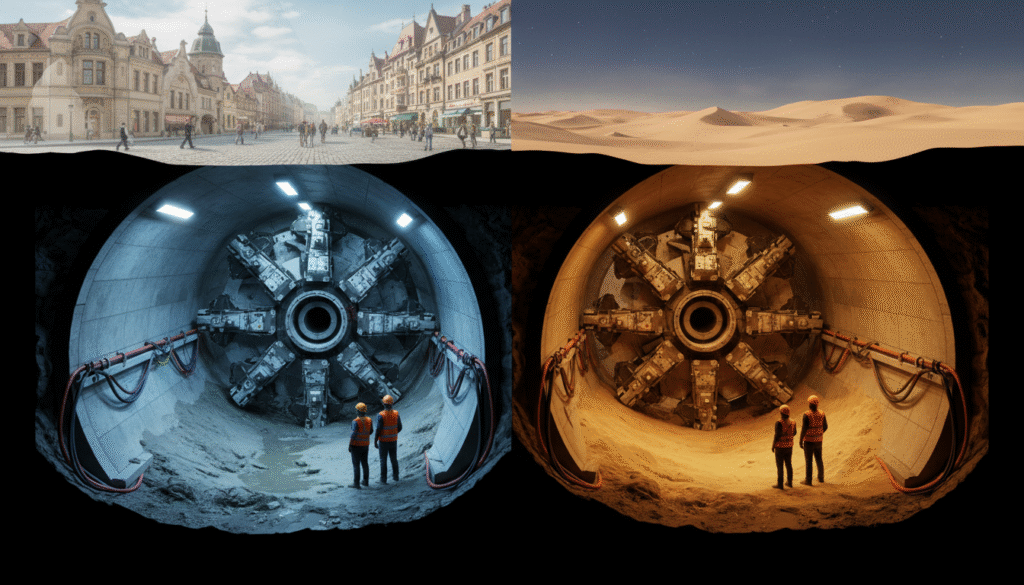
This is the rhythm of desert construction: not the steady advance of European projects, but a choreography constrained by thermal limits. The same Tunnel Boring Machine that advances through Milan’s clay faces different constraints in Riyadh—not because the ground is harder, but because the logistics of heat reshape every operational decision.
The Thermal Shock
In Milan, the tunnel excavation maintains a stable 15-20°C year-round. The concrete cures uniformly—surface and core at the same temperature, expanding and contracting together. The hydration heat dissipates gradually into the surrounding ground, and 28 days later the segment reaches its design strength without thermal distress.
In Riyadh, the concrete warms twice: first from the ambient heat of the desert night (28°C), then from its own chemical reaction as the cement hydrates—typically generating 250-300 kJ per kilogram. But the real danger comes at sunrise. The outer surface exposed to solar radiation can hit 60°C while the core remains at 35-40°C, creating a thermal gradient across 30 centimeters of fresh concrete. The surface expands; the core resists. When the differential exceeds 20°C, the risk of thermal cracking becomes critical—microfractures that compromise structural integrity before the segment ever leaves the yard.
The response is chemical. Engineers replace 50-60% of the Portland cement with ground granulated blast-furnace slag (GGBS), which reduces the heat of hydration significantly while improving long-term strength. Microsilica is added—5-8% by weight—to densify the microstructure, though this requires high-range water reducers (superplasticizers) to maintain workability in the heat. Curing compounds are applied immediately after pouring, creating a membrane that holds moisture in for the critical first 72 hours.
Even then, segments remain in controlled storage for 35-42 days before installation, compared to 28 in temperate climates. The tunnel advances slower not because the TBM is weaker, but because the concrete demands time to achieve strength without tearing itself apart.
The Sand That Gets Inside
Desert sand is not the coarse grit of European beaches. It is crystalline silica, with a significant fraction below 75 micrometers—fine enough to bypass standard air filtration and infiltrate sealed enclosures through pressure differentials created by solar heating. The TBM is theoretically sealed, but theory faces reality in the Arabian Peninsula.
The main bearing seals, designed for European clay and rock, face an abrasive onslaught that accelerates wear. Air filtration systems require daily inspection and cleaning, with multi-stage filtration becoming necessary rather than optional. The screw conveyor, transporting conditioned spoil from the cutterhead chamber, handles an abrasive slurry of soil, foam, and silica particles that accelerates wear on steel surfaces.
The response is intensive maintenance. Where a European site might service the TBM on weekly cycles, desert operations demand daily rituals. Compressed air purges every crevice. Filters are inspected and changed on schedule, not when clogged. The Mean Time Between Failures (MTBF) becomes a critical metric, monitored more closely than advance rates.
Logistics in the Empty Quarter
In Milan, a broken seal or a failed sensor triggers a phone call. The part arrives within hours from local suppliers clustered around the city. In Riyadh, the same failure initiates a supply chain spanning days. Critical components must come from Jeddah, Dubai, or Europe.
Stockholding becomes strategic. Every critical component exists in triplicate: main bearing seals, hydraulic pumps, PLC modules. The storage yards resemble small industrial parks, climate-controlled containers holding inventory against the day of failure. The carrying cost is significant—capital tied up in parts that may never be used—but the alternative is a TBM stopped for weeks awaiting a seal that costs less than a single day of site overhead.
The Human Factor
Safety protocols in extreme heat are non-negotiable. Above 40°C ambient, the human body’s evaporative cooling becomes inefficient. The standard mandate is forced hydration—250ml of water every 15 minutes, regardless of thirst. But this creates operational friction: workers must exit the tunnel frequently, and productivity drops as the body struggles to thermoregulate.
Heat stress monitoring becomes as critical as TBM guidance. Workers wear core temperature monitors—sensors tracking body heat in real time. If a worker’s temperature rises above 38.5°C, they are removed immediately. Heat exhaustion is not a possibility; it is a certainty if vigilance relaxes.
The desert schedule is absolute: surface operations run from 19:00 to 04:00, with mandatory cessation during midday peak temperatures. The effective construction window compresses to 60-70% of European rates. The same tunnel takes longer in the desert, not because the geology is harder, but because the operational constraints—thermal, logistical, biological—multiply.
Two Cities, One Goal
And yet, the fundamentals remain identical. Whether beneath the cobblestones of Milan or the sand dunes of Riyadh, a metro tunnel must be circular, lined with precise segments, guided by laser targets. The TBM does not care about the temperature outside its shield. The concrete must cure, the rails must align, the platforms must be level.
But the environment shapes the method. Milan requires managing groundwater, respecting the fragility of historic foundations, navigating dense urban logistics. Riyadh demands managing thermal gradients, planning for supply chain latency, working within the narrow window between sunset and heat.
Conclusion: Engineering Without Complacency
Building railways in extreme environments strips away illusions. There is no “standard condition,” no universal template. The sand of Riyadh and the clay of Milan are equally unforgiving, merely different in their hostility.
The desert does not negotiate. It does not care about project timelines or technical specifications. It simply exists—a thermal and abrasive reality that must be acknowledged, respected, and engineered around. And when the last segment is installed, when the TBM breaks through and the night shift ends, the desert remains, waiting for the next project, the next challenge, the next group of engineers learning that infrastructure is always a dialogue between human ambition and environmental reality.
Stay with Beyond Tracks as we continue exploring how geography, climate, and geology shape the railways of tomorrow—one extreme environment at a time.